Most AI influencer projects stall at the same place: the persona looks good, the videos render cleanly, and nothing makes money. The reason is usually that the persona was built as a follower- count play, which is the slowest and least reliable of the four routes available to it. This guide covers all four, in rough order of how quickly they pay, and the operational detail that decides whether they work.
The four routes, honestly ranked
An AI persona can earn in four distinct ways. They have very different time-to-revenue, and the one everybody starts with is the one that pays last.
- Ad creative for your own product — fastest. No audience required, because paid distribution supplies it. Revenue shows up as reduced creative production cost and improved performance, which is real money even though it never looks like an invoice.
- Selling content production as a service — fast. You own a persona and a workflow; brands pay for the output. This is the clearest route for agencies and freelancers and it needs no following at all.
- Affiliate and performance deals — medium. Needs a modest, engaged audience, and pays on conversion rather than reach, which suits a persona in a narrow niche far better than a broad lifestyle one.
- Sponsored brand deals — slowest. Requires a genuine audience and a media kit, and this is the one most people mistakenly build toward first.
If you want revenue this quarter rather than next year, build for routes one and two and treat any audience you accumulate as a bonus.
Route 1: Turn the persona into ad creative
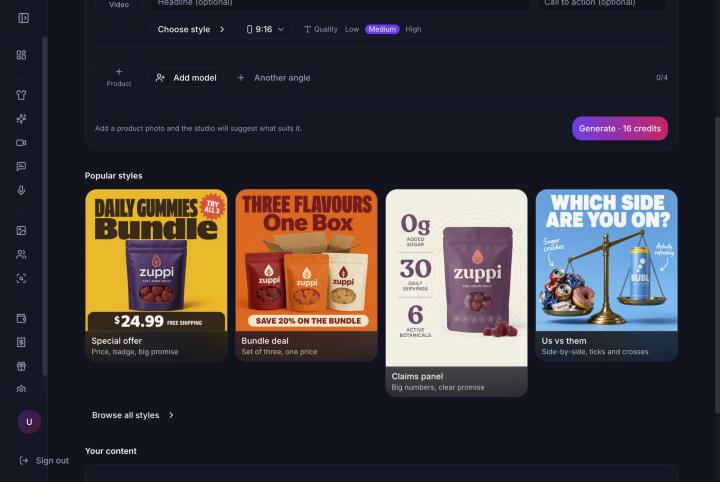
This is where a consistent face compounds fastest. In Ad Studio you hand over a product and a style and get back ad-shaped output — image or video — rather than a generic render you then have to lay out yourself.
The style library is the part that matters commercially, because it's organised by ad job rather than by aesthetic: special offer, bundle deal, claims panel, us-versus-them comparison. Those map onto the things that actually get tested in a paid account, which means you can run a structured creative test rather than generating variations and hoping.
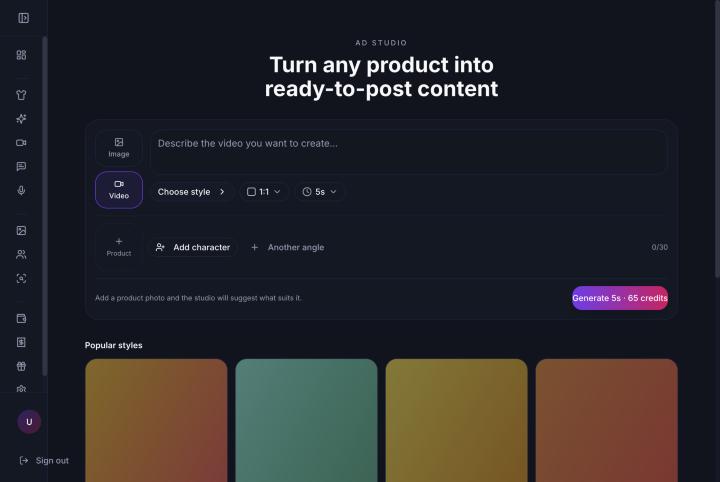
The video side runs the same way with a duration control, and the labelling is a useful hint about intent: 5 seconds is marked the feed default, 8 seconds is marked as room for a beat. If you're testing a hook, the shorter one is usually the honest test. If the creative needs a turn — a reveal, a before-and-after — the extra three seconds is what buys it.
The economics here are the whole argument. A persona you already own, used across a batch of ad variations, removes the per-shoot cost that normally caps how many creative ideas you can test. For the full workflow see scaling ad creatives with a brand kit.
Route 2: Sell the production, not the persona
The most reliable early revenue is other people's content. Brands need volume they can't produce; you have a workflow that produces it. No audience is involved at any point.
Three things make this work in practice. Price per deliverable, not per hour — the client is buying a batch of videos or images, and hourly pricing punishes you precisely as you get faster. Sell batches, not one-offs, because a single video can't be judged and a set of ten can. And decide who owns the persona before the first invoice: a character you keep lets you serve many clients, while one built for a client is work-for-hire and should be priced as such. Getting that backwards is the most expensive mistake in this route.
Route 3: Affiliate and performance
Affiliate pays on conversion, which changes what a good persona looks like. Reach stops mattering and specificity starts to. A persona covering one narrow category with genuine depth will out-earn a broad lifestyle persona with several times the following, because the audience arrives already in the market.
This route rewards consistency over volume: the same face, the same category, repeatedly, until the persona is a known quantity within a small niche. It's slower than the first two and considerably more durable.
Route 4: Sponsored deals
Brand deals need an audience, so this is a months-long play rather than a weeks-long one. Two things are specific to AI personas here. First, brands will ask directly whether the persona is AI — have the answer ready and documented, because being evasive loses the deal outright. Second, your pitch is not reach; it's control. You can produce a revision in an hour, run the same script across five variants, and guarantee the persona never posts something that embarrasses the brand. For a human creator those are hard promises. For you they're the default.
Disclosure is a commercial asset
Treating disclosure as a compliance chore is a mistake. Audiences and platforms increasingly expect AI content to be labelled, and the brands worth working with will ask regardless. Being unambiguous from the start costs you nothing and removes the single largest tail risk in the whole model — a persona exposed as AI after implying otherwise.
Decide the wording once, apply it everywhere, and keep it visible rather than buried. Pixla's AI disclosure page is a reasonable model for the tone.
Build a roster, not a character
Once one persona is producing, the obvious growth move isn't more posts from that persona — it's more personas. Each one is a fresh audience segment, market or product line, and the marginal cost of the second is far below the first because the workflow already exists.
- Segment by audience, not by whim — a persona per market or product line.
- Reuse what works. A hook that performs for one persona is a tested starting point for the next.
- Localise rather than rebuild. Dubbing an existing winner is cheaper than producing a new video per language.
- Keep the character sheets. Three personas without written voice rules will converge into the same voice within a month.
Know your unit economics
Every route above lives or dies on one number: fully-loaded cost per usable asset. Not per generation — per asset you'd actually publish, which includes the ones you discarded.
Track it honestly for a week. Count the character build, the generations that missed, the voice cost, and your own time. That figure tells you what to charge in route two, what a conversion has to be worth in route three, and whether route one is beating whatever you were spending on creative before. Without it you're guessing, and most people guess generously in their own favour. Current credit packs are on pricing.
Start here
If you haven't built the persona yet, start with how to create an AI influencer and then how to make AI influencer videos. If the persona already exists, route one is the shortest distance to a number you can measure.
Frequently asked questions
How do AI influencers make money?
Four ways: producing ad creative for your own product, selling content production to brands as a service, affiliate and performance deals, and sponsored brand deals. The first two need no audience at all and pay fastest; sponsored deals need a real following and take longest, which is why building primarily for follower count is usually the slowest path to revenue.
Can you monetize an AI influencer without followers?
Yes, and it is the quickest route. Using the persona for your own paid ad creative needs no audience because paid distribution supplies it, and selling content production to brands is a service business where your workflow is the product rather than your reach.
Should I tell brands the influencer is AI?
Always, and have it documented before you pitch. Brands ask directly, and being evasive loses the deal. Your pitch is control rather than reach — fast revisions, multiple script variants, and a guarantee the persona never posts anything off-brand, all of which are harder promises for a human creator to make.
How many AI influencers should I run?
Start with one and prove it earns, then add personas per audience segment, market or product line rather than posting more from a single one. The marginal cost of the second persona is much lower because the workflow already exists, but keep written voice rules for each or they converge into the same character.
How do I work out whether an AI influencer is profitable?
Track fully-loaded cost per usable asset — per asset you would actually publish, including the generations you discarded, plus the character build, voice cost and your own time. That single number tells you what to charge for production work, what a conversion needs to be worth on affiliate deals, and whether ad creative is beating your previous production spend.